Moulds
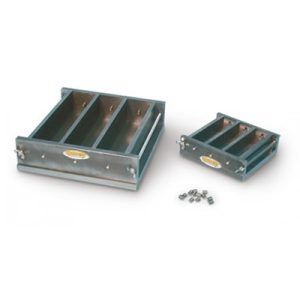
Moulds for cubes and prisms used to produce standardized specimens for testing and quality control in accordance with Norwegian Standards.
We supply a wide range of moulds for testing cement and mortar.
Plastic moulds are lightweight and easy to handle, while steel moulds are often more durable and can provide a better surface finish.
Cube moulds and prism/beam moulds are available in many different dimensions and for various test methods.
Production of Concrete/Mortar Specimens
The production of concrete or mortar cubes is an important process to ensure that the material is properly compacted and free of air voids. Below is a step-by-step guide:
Casting of Specimens
- Moulds: Pour the mixed mortar into standardized moulds (e.g. cubes or prisms) that are clean and coated with mould oil to facilitate demoulding.
- Compaction: Compact the mortar in the moulds to remove air bubbles and ensure a smooth, even surface.
Removal of Specimens
- Demoulding: Carefully remove the specimens from the moulds after 24 hours.
- Curing: Place the specimens in a curing bath or a humid chamber for further curing in accordance with the standards (typically 7, 14, or 28 days).
Cleaning the moulds immediately after use is important.
Testing of Hardened Mortar
- Compressive Strength: Use a compression testing press to measure the compressive strength of the mortar specimens. This is performed by applying a gradually increasing load until the specimen fails.
- Flexural Strength: For prismatic specimens, perform flexural strength tests by applying a load at the midpoint of the specimen until failure.
Standards: EN 459-2, EN 101
Mortar Moulds Matest
Download brochure
Mortar Moulds
Download brochure


We support success from the ground up
