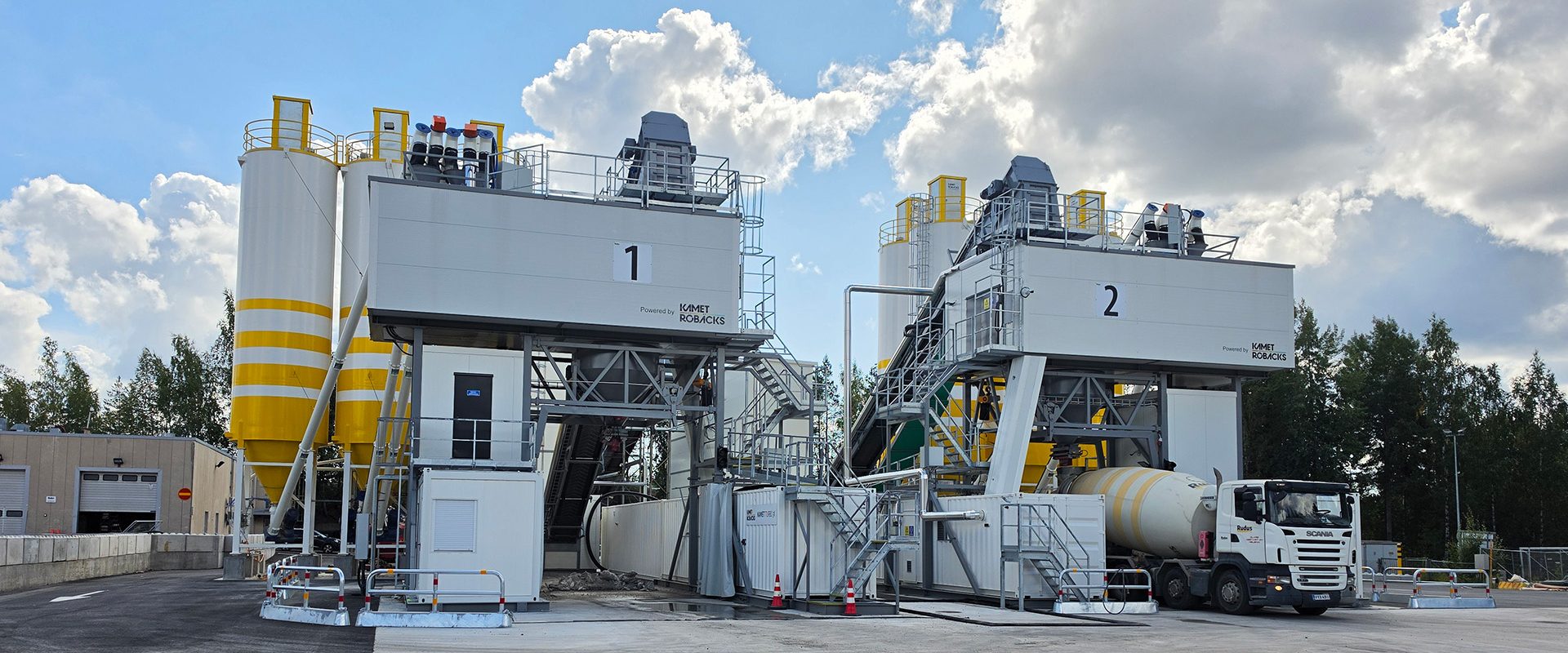
Kamet-Röbäcks delivered a new two-line concrete mixing plant to Rudus in Konala, Helsinki. Designed around Rudus’ specific requirements, the plant increases production efficiency while providing flexibility in the use of raw materials and adapting to future changes. The Express solution can also be relocated if needed.
Rudus’ old concrete mixing plant in Konala had been in service for more than 40 years. Although the equipment dating back to the 1980s was still operational, Rudus wanted to modernize its production to meet future needs.
The primary objective was to improve production reliability and efficiency. For example, instead of the previous single loading line, the new plant has two parallel lines, allowing two concrete mixer trucks to be loaded simultaneously.
“Concrete deliveries often peak during the same morning hours. When trucks do not have to wait to be loaded, transport becomes more efficient and customers receive their concrete faster. It is a win-win situation for everyone,” says Pasi Huttu, Business Director at Rudus.
A solution designed around the needs of the Konala site
The Konala project was not based on an off-the-shelf solution. Kamet-Röbäcks designed the plant around the existing production environment, allowing parts of the existing infrastructure to be retained.
“The layout worked extremely well. We were able to fit this large-scale solution exactly where Rudus wanted it,” says Mikko Rautio from Kamet-Röbäcks.
Relocatability was one of the key requirements. Although Rudus owns the Konala site, land use in the Helsinki metropolitan area may change in the future due to factors such as urban planning and new development.
This is why the plant was implemented using Kamet-Röbäcks’ Express solution. If necessary, the plant can be dismantled and relocated to a new site. The two-line configuration can also be separated into two independent plants.
“In the past, large concrete plants were built with the expectation that they would remain in the same location for 50 years. Today, the operating environment can change much faster. That is why it is important that equipment with plenty of service life left can be relocated elsewhere at a reasonable cost,” Huttu says.
Greater flexibility in the use of raw materials
The new concrete mixing plant gives Rudus more options for using different aggregates and binding agents. For example, Konala receives concrete from demolition and surplus concrete, which can be crushed and reused as aggregate.
The two-line configuration enables different materials to be used side by side. The selection of binding agents can also be adapted according to the required properties of the concrete and factors such as its carbon footprint.
Water recycling further improves resource efficiency. Water generated when washing concrete mixer trucks can be reused in concrete production.
Long-term cooperation and expertise in northern conditions
Rudus and Kamet-Röbäcks have worked together for several years, and Rudus already had experience with Express solutions before the Konala project. Their long-standing cooperation and Rudus’ confidence in Kamet-Röbäcks’ expertise were also factors in the choice of supplier.
Expertise in northern production conditions was particularly important in the Konala project. A concrete mixing plant must operate reliably throughout the year, even though the process involves water and liquid admixtures, while aggregates can freeze during winter.
“A manufacturer operating in Finland understands what working in genuinely cold conditions requires. Heating needs to be directed to the right places so that the plant can operate efficiently in winter as well,” Huttu says.
Kamet-Röbäcks’ in-house engineering and production in Finland also made it possible to adapt the solution to the specific requirements of the Konala site and respond flexibly to changes during the project. According to Rautio, integrating such a large-scale solution into the existing production environment went according to plan.
The Konala plant is already in production. At the time of the interviews, final finishing work and testing related to final acceptance were still under way.
Looking back on the companies’ long-standing cooperation, Huttu particularly highlights open communication and the ability to solve issues together as they arise.
“We have had good communication with Kamet-Röbäcks throughout. In projects like this, you naturally negotiate pricing, contract terms and many other matters, but everything has always been handled in a constructive spirit. Over the years of working together, we have built a strong relationship of trust,” Huttu concludes.
Rudus’ Konala concrete mixing plant
- 2 independent production lines that can be operated in parallel or separately
- 10 aggregate bins, compared with the previous five
- 9 binding agent silos, with provision for increasing the number to 12
- possibility to use recycled aggregate
- recycling of wash water for use in concrete production
- 60 m³ buffer water tank to balance the plant’s water demand
- relocatable Express solution that can be separated into two independent plants if required
Other News


We help you to create a firm foundation for your success
